As of 1 July 2026, Austria taxes a selected list of foods at a new 4.9% VAT rate — a third reduced band slotted in below the existing main 10% and 20% rates (§ 10 Abs. 1a UStG 1994, introduced by BGBl. I Nr. 37/2026). The new 4.9% rate applies only to the goods enumerated in the law’s Anlage 3:
- Animal products: milk (including lactose-free), yoghurt, butter, and fresh hens’ eggs.
- Plant staples: most fresh, chilled and frozen vegetables; a subset of fruit (apples, pears and quinces; apricots, cherries, peaches and plums); rice; wheat flour and semolina; plain (uncooked, unfilled) pasta; bread; and table salt.
- Meat was left out. It stays at the 10% rate. During the negotiations at least one party pushed to include meat in the cut; that was avoided.
- Plant-based alternatives for the included animal products were left out — they carry a 10% VAT markup, while plant-based milk alternatives remain in the 20% bracket, more than four times the dairy rate of 4.9%.
The political framing is relief for households on “basic foodstuffs” after substantial cost-of-living increases over the past years. The problem is that the list was drawn up as a negotiation between interest groups, not as evidence-based policy. Judged against what the scientific literature actually says about food, the measure is at best a missed opportunity — and in parts it pushes in the wrong direction. Additionally, given the high concentration of the Austrian retail sector, the price reduction may evaporate anyway.
What logic could have driven this decision?
When consumers pay at the checkout, the price reflects production, transport, retail margins and tax. What it does not reflect are the costs food production imposes on everyone else — what economists call externalities: greenhouse-gas emissions, biodiversity loss and land-use pressure, water and nutrient pollution, and the health-system burden of diet-related disease. Because these costs sit outside market prices, society pays them anyway, through healthcare, environmental remediation and a degraded environment for future generations.
The scale is not marginal. The Food and Agriculture Organization puts global food-system externalities at $10–12 trillion a year — roughly 10–12% of global GDP (FAO, 2023; FAO, 2024; Ruggeri Laderchi et al., 2024); broader accounts reach $15–20 trillion (Hendriks et al., 2023). In other words, the hidden costs of the food system are of a similar magnitude to the market value of the food system itself. Any intervention that moves the food system in the “right” direction — something still to be defined — has potentially far-reaching positive effects by reducing negative externalities.
So what is the “right” direction?
As a reference point, the scientific consensus is captured by the EAT–Lancet planetary health diet: a largely plant-based pattern — rich in vegetables, fruit, whole grains, legumes and nuts, with only modest amounts of animal products — that is compatible with both human health and planetary boundaries (Willett et al., 2019). A food-tax system aligned with the evidence would nudge consumption in that direction. Austria’s reform, as we will see, does the opposite where it matters most.
The dividing line the law gets backwards
What is to be significantly reduced by the Planetary Health Diet are the massive GHG emissions of the food system – 1/3 of global GHG emissions – of which close to 60% of emissions are due to the huge consumption of animal products. Likewise animal keeping is the major driver in biodiversity loss and environmental pollution as well as non-communicable diet related diseases such as coronary heart diseases, stroke, cancer, respiratory diseases and type 2 diabetes. As animal keeping is occupying about 80% of agricultural land – both for feed production and pasture – the opportunity costs are huge as the land can not be renatured or reforested. Reforested or renatured land would be a huge carbon sink and bring the 1,5°C warming objective within reach again (see Sun et al., 2022, Pure – Nemecek, 2018, see also Plinke, Sureth & Kalkuhl, 2026). Presently, due to the increasing adoption of Western style diets in successfully catching-up countries, the GHG emissions together with the other unwanted side-effects of the food system are expected to grow massively until 2050 (Springmann et al, 2016). The food sector is complex, but the main driver of its negative impact is the overconsumption of animal products.
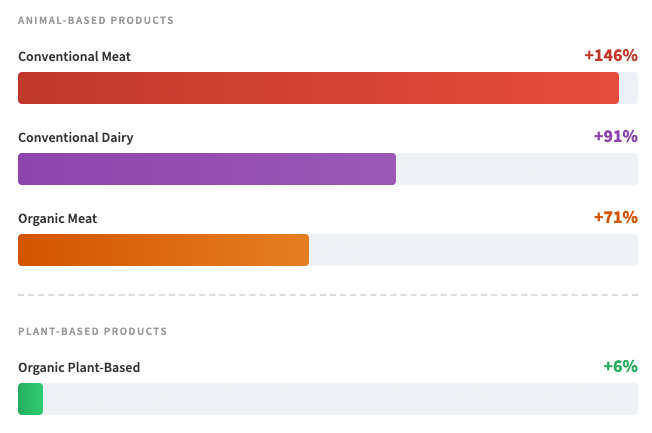
Figure 1: Price Increases Needed to Reflect True Environmental Costs
Srce: Pieper, Michalke & Gaugler, 2020.
What evidence-based VAT would look like
In the presence of externalities, the economist’s recommendation is always to add external costs to prices, so that consumers decide on the basis of correct price signals and socially desirable choices follow. By the same logic, VAT rates should be lowest for the products that do the least harm and highest for those that do the most.
Pieper, Michalke and Gaugler (2020), in Nature Communications, did exactly this for the food sector: they quantified what prices would look like if external climate costs alone(!) were internalised. Conventional meat would need to be 146% more expensive and conventional dairy 91% more expensive, while organic plant-based products would need only about 6% price increase. In other words, reflecting climate costs alone would nearly double the price of dairy — and this still omits the external costs of biodiversity loss, environmental degradation and damage to human health. An all-encompassing calculation would push the mark-ups on animal products higher still.
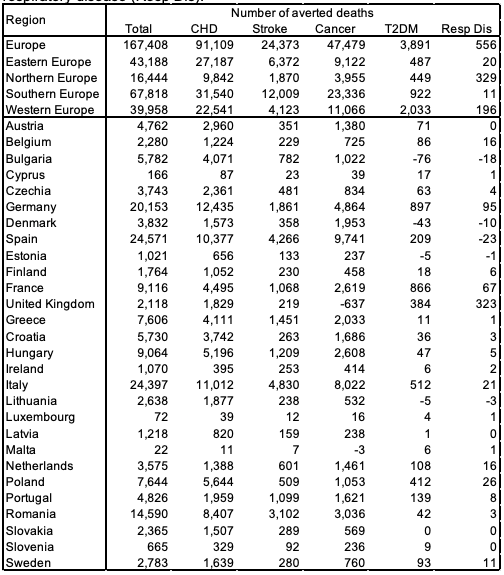
This is not merely theoretical. Modelling a Europe-wide version of precisely this reform — no VAT on fruit and vegetables and 20% VAT on meat and dairy — Springmann and colleagues (2025) find it would avoid roughly 170,000 diet-related deaths (see table 1) – 4762 avoided premature death is the figure for Austria. Additionally, this reform would cut greenhouse-gas emissions, land use and water use by about 6%, and raise public revenue by tens of billions of euros, all while leaving average diet costs virtually unchanged. Tellingly, the health gains come mainly from the cheaper plant foods and the environmental gains from the dearer animal products.
Table 1: Number of averted deaths by cause of death and region in the scenario of combined VAT changes in fruits and vegetables and on meat and dairy. The causes of death include coronary heart disease (CHD), stroke, cancer, type-2 diabetes (T2DM), and respiratory disease (Resp Dis).
Source: Springmann et al, 2025b.
In the Austrian context, the 4.9% bracket would be reserved for unprocessed plants. Animal products would sit mostly in the highest bracket (20%). The 10% bracket would cover processed vegan products, to strengthen the incentive to switch away from high-externality animal products. This arrangement would internalise the climate-related external costs of plants and processed vegan products to a large extent, while dairy and beef in the highest VAT bracket would still bear only roughly 15–25% of their external costs.
Although only a fraction of the externalities of even the highest-taxed products would be internalised, the effects would be substantial. Removing existing VAT reductions on meat across the EU would cut food-related greenhouse-gas emissions, land use and biodiversity loss by about 5%, at a net welfare cost of only about €12–26 per household per year — which redistributing the revenue can largely offset (Plinke, Sureth & Kalkuhl, 2026). Modest cost, real benefit — and the exact reverse of what the Austrian VAT reform is doing. Biodiversity loss and environmental degradation would also slow, while human health would improve (lower morbidity and mortality).
The Austrian VAT reform is therefore part of a long list of food-sector decisions that are not evidence-based but mostly irrational and driven by lobby interests that have captured politics. The VAT reform would have been an opportunity to do the right thing in order to reign in the negative externalities of the food system. While this sounds fairly abstract, the real consequences of an evidence-based VAT reform would have been more than 4000 avoided premature deaths and significant reductions in greenhouse-gas emissions, land use and water use without putting a burden on public finances. Given these straightforward and substantial positive effects, the current VAT reduction is clearly a missed opportunity and will reduce public tax revenue by about €400 millions annually (BMF, 2026).
Hannes Leo is CEO of cbased, a research consultancy focused on evidence-based policy at the intersection of innovation, digitalisation and sustainable food systems.
Korea Study Excursion — Autumn 2026: cbased is organising a curated four-day study excursion to South Korea for policymakers, researchers and innovators from across the EU — visiting alternative-protein facilities and meeting Korean policymakers and researchers to see how one country is turning food-system evidence into policy. Free online info meeting: Thursday, 23 July 2026, 15:00 CEST. Learn more and register at https://cbased.com/korea-landing-page.
References
BGBl. I Nr. 37/2026. Bundesgesetz, mit dem das Umsatzsteuergesetz 1994 geändert wird. Ausgegeben am 10. Juni 2026; in Kraft ab 1. Juli 2026.
BMF, Senkung der Umsatzsteuer auf Grundnahrungsmittel zur Bekämpfung der Teuerung im Lebensmittelbereich, Vortrag an den Ministerrat, 2026-0.081.506 (BMF), 2026, https://www.bundeskanzleramt.gv.at/dam/jcr:669fec2a-1cba-4893-bb60-3096a041f995/39_13_mrv.pdf
European Scientific Advisory Board on Climate Change (ESABCC) (2024). Towards EU climate neutrality: progress, policy gaps and opportunities. (Recommends shifting agricultural support away from livestock.) — citation to be verified against the primary document.
FAO (2023). The State of Food and Agriculture 2023: Revealing the True Cost of Food. Rome.
FAO (2024). The State of Food and Agriculture 2024: Value-driven transformation of agrifood systems. Rome.
Flysjö, A. (2011). Potential for improving the carbon footprint of butter and blend products. Journal of Dairy Science, 94(12), 5833–5841.
Hendriks, S., et al. (2023). The True Cost of Food: A preliminary assessment. In Science and Innovations for Food Systems Transformation. Springer.
International Journal of Life Cycle Assessment (2020), 25(6). Large-scale regionalised LCA shows that plant-based fat spreads have a lower climate, land occupation and water scarcity impact than dairy butter. (Study conducted by Quantis; funded by Upfield.)
Kortleve, A.J., et al. (2024). Over 80% of the European Union’s Common Agricultural Policy supports emissions-intensive animal products. Nature Food. https://doi.org/10.1038/s43016-024-00949-4
Pieper, M., Michalke, A., & Gaugler, T. (2020). Calculation of external climate costs for food highlights inadequate pricing of animal products. Nature Communications.
Plinke, C., Sureth, M., & Kalkuhl, M. (2026). Environmental impacts from European food consumption can be reduced with carbon pricing or a value-added tax reform. Nature Food, 7, 74–87.
Poore, T. Nemecek, Reducing food’s environmental impacts through producers and consumers, Science, 01 Jun. 2018, Vol. 360, Issue 6392, https://science.sciencemag.org/content/360/6392/
ProVeg International (2024). Evolving Appetites: Diet shifts across ten countries (survey of 7,500 consumers with Innova Market Insights, University of Copenhagen and Ghent University). Austria’s vegan share rose from 3% (2021) to 5%, among the highest in Europe. Reported via vegconomist, 2024.
Ruggeri Laderchi, C., et al. (2024). The Economics of the Food System Transformation. Food System Economics Commission.
Springmann, M., & Freund, F. (2022). Options for reforming agricultural subsidies from health, climate, and economic perspectives. Nature Communications, 13, 82. https://doi.org/10.1038/s41467-021-27645-2
Springmann M, Spajic L, Clark M A, Poore J, Herforth A, Webb P et al., 2020a, The healthiness and sustainability of national and global food based dietary guidelines: modelling study, BMJ 2020; 370 :m2322 doi:10.1136/bmj.m2322
Springmann M, Spajic L, Clark M A, Poore J, Herforth A, Webb P., Rayner, M., Scarborough, P., 2020b, The healthiness and sustainability of national and global food-based dietary guidelines: modelling study, Supplementary information, BMJ 2020; 370 :m2322 doi:10.1136/bmj.m2322
Springmann, M.. Charles, H., Godfray, J., Rayner, M., Scarborough, P., Analysis and valuation of the health and climate change co-benefits of dietary change, PNAS, 2016, https://www.pnas.org/content/pnas/early/2016/03/16/1523119113.full.pdf
Springmann, M., Dinivitzer, E., Freund, F., Jensen, J. D., & Bouyssou, C. G. (2025a). A reform of value-added taxes on foods can have health, environmental and economic benefits in Europe. Nature Food, 6(2), 161–169. https://doi.org/10.1038/s43016-024-01097-5
Springmann, M., Dinivitzer, E., Freund, F., Jensen, J. D., & Bouyssou, C. G. (2025b). A reform of value-added taxes on foods can have health, environmental and economic benefits in Europe. Supplementary information. Nature Food, 6(2), 161–169. https://doi.org/10.1038/s43016-024-01097-5
Sun, Z., Scherer, L., Tukker, A., Spawn-Lee, S. A., Bruckner, M., Gibbs, H. K, Behrens, P., Dietary change in high-income nations alone can lead to substantial double climate dividend, Nature Food, volume 3,, 2022.
The Lancet Commission, Food in the Anthropocene: the EAT–Lancet Commission on healthy diets from sustainable food systems, 2019, https://www.thelancet.com/action/showPdf?pii=S0140-6736%2818%2931788-4
Vasilaki, V., Katsou, E., Ponsa, S., & Colon, J. (2016). Water and carbon footprint of selected dairy products: A case study in Catalonia. Journal of Cleaner Production, 139, 504–516.
Vegane Gesellschaft Österreich (2026). Petition gegen die steuerliche Benachteiligung von Pflanzendrinks (>7,600 Unterschriften). vegan.at. Plant drinks are taxed at the 20% standard rate; cow’s milk at 4.9% (from July 2026).
Verein für Proteinvielfalt in Österreich (2026). Mit gesenkter Mehrwertsteuer auf pflanzliche Proteinquellen und Lebensmittel mehr bewirken. Vienna, 17 Feb 2026. (Market figures from RollAMA H1 2025 and NielsenIQ; budget and agriculture estimates by the association.)
Willett, W., et al. (2019). Food in the Anthropocene: the EAT–Lancet Commission on healthy diets from sustainable food systems. The Lancet, 393(10170), 447–492.